DictionaryA to ZPublished October 2026
Watching as a Way of Life
A Dictionary of Mass Surveillance
Watching as a Way of Life is a sociological dictionary of mass surveillance and its interaction with penal governance. The dictionary constitutes 26 terms which provide a critical sociological framing to the relationship between mass surveillance and the criminal justice system. The terms have emerged from extensive engagement with scholarship across disciplines such as political science, sociology and law.

The A to Z of surveillance
Tap a card to flip itClick a card to flip it
 A
Algorithm
Flip backthe set of instructions programmed into technology to analyse relationships between socio-personal information such as demographic data, biometric data and communication records.
Algorithmic analysis is done to make predictions regarding various aspects of criminal activity such as suspects and sites of risk. The use of algorithms puts vast amounts of information from ordinary life under scrutiny. Algorithmic surveillance also risks making ineffective and hollow correlations between the crime and minute, disparate details of individual lives.
See:Verhelst HM, Stannat AW and Mecacci G, (2020) Machine Learning Against Terrorism: How Big Data Collection and Analysis Influences the Privacy-Security Dilemma.
 B
Base Data
Flip backthe information inputted into the algorithm as reference.
Base data includes pre-existing documents such as habitual offenders’ list, terror suspect list, crime maps etc. Made at different points in time for varied purposes, these records associate certain time, location, communities and individuals with criminality. When the algorithm learns from base data, the assumptions of actors and institutions that prepare such data are sustained. These assumptions get replicated when the algorithm identifies and categorises objects, people and spaces. Hence, the human subjectivity in base data that is inputted into technology stays intact in the output that is created.
See:S Narayan, (2023) Predictive Policing and the Construction of the ‘Criminal’: An Ethnographic Study of Delhi Police.
 C
Chilling Effect
Flip backthe self-censoring of actions, speech and movement in fear of state retaliation due to vague laws.
A vague legal framework governs mass surveillance and its use by criminal justice institutions in India. The details regarding the kind of behaviour, speech, bodily expression that can be marked as suspicious by surveillance technology is also unclear (See I). The absence of clarity regarding the ways in which surveillance recognises suspicion and the penal consequences that can follow can further heighten anxieties in society. The chilling effect of mass surveillance hinders the free expression of speech and behaviour, including actions that may not even be criminalised.
See:Murray D, Fussey P, Hove K, Wakabi W, Kimumwe P, Saki O and Stevens A, (2024) The Chilling Effects of Surveillance and Human Rights: Insights from Qualitative Research in Uganda and Zimbabwe.
 D
Discipline
Flip backthe social process leading to the internalisation of the behavioural and cognitive expectations of institutions such as schools, prisons, family, religion and the government.
Surveillance performs the disciplinary function for state and society. Constantly being watched ensures that people’s personhood is developed per the morality of the police and the state. As the authority of the ‘watcher’ becomes internalised, the physical presence of the police or even the camera is no longer necessary. Through surveillance, the state’s morality gets structured within people, eventually shaping their subjectivity. Surveillance is hence a modality of the state through which its own authority gets decentralised.
See:Foucault M, (1975) Discipline and Punish: The Birth of the Prison.
 E
Environment of the Urban
Flip backthe aesthetic architecture of urban space.
Mass surveillance schemes are proposed as part of larger urban development projects such as ‘smart cities.’ Mass surveillance is hence being infused as a component of the aspirational urban design. This design, however, deploys mass surveillance technologies unequally across spaces and socio-political groups. While certain spaces of the urban are surveilled because they are presumed to be vulnerable to threats, others are surveilled because they are suspected to cause the threat. Hence the use of mass surveillance in service of the urban aesthetic reinforces the unequal ways in which the urban inhabitants are policed.
See:Hayward K, (2026) Criminology and the smart city paradigm: ‘Preventative technical imaginary’ or ‘Techlash’ vector?
 F
Fear
Flip backa heightened sense of threat regarding a potential future disaster.
Fear is a dominant, wide-spread emotion characterising contemporary societies. It is expected to be a task of governance to direct social and political energies to manage this threat of potential future disasters including crime (See H). It is this paranoia and desire to eliminate threats that motivates how ‘security’ is conceptualised. The successful selling of mass surveillance as an important tool to manage crime is reliant on the continuity of fear and how it shapes notions of security.
See:Neocleous M & Rigakos G. S, (2011) Anti-security.
 G
Geography of Surveillance
Flip backthe extent of space, time and breadth of information that can be captured by mass surveillance.
Mass surveillance expands the limits of people, time, territory and breadth of information that can be recorded by state infrastructure. The ‘geography of surveillance’ transforms the target of policing. As surveillance records ‘spots’ and ‘zones,’ the police’s suspicion is not limited to specific individuals or a particular crime. All spaces and those who inhabit them, at all possible times become suspicious. Surveillance prepones suspicion, broadens the pool of suspects and generalizes suspicion outside of particularised instances.
See:Brayne S, (2017) Big data surveillance: The case of policing.
 H
High Modernist Ideology v. High Crime
Flip backthe wide-spread faith in the potential of scientific and technological progress to serve human development.
For high modernist ideology, predictability and objectivity become central values of governance. High modernist ideology builds the faith in mass surveillance, making it seem possible to accurately predict future crime by using scientific methods and accordingly prevent it. The rise of mass surveillance is not an intuitive organic state response to crime but connected to a worldview where future social outcomes are perceived to be controllable and this control is deemed desirable.
See:Scott J.C, (1998) Seeing Like a State: How Certain Schemes to Improve the Human Condition Have Failed.
 I
Informants
Flip backthe surveillance infrastructure that serves as the police’s new informants in India.
In India, mass surveillance infrastructure that the police rely on includes CCTV cameras, biometric information such as facial scans and fingerprints, and communication data. Different private institutions also collect data regarding market behaviour, bodily movement, health, banking details etc. There is immense ambiguity regarding if and how this vast and diverse information collected for different purposes by state and non-state actors is being used for police functions. This all-encompassing depth of information currently has no clear limits on the purposes and manner of its use specifically for its criminal law related functions.
See:Agarwal B, & Saxena S, (2026) Digital Panopticons on Wheels: A Comparative Legal Analysis of Police Vehicle Tracking and Surveillance in India, West, and South Asia in The Intersection of Technology and Criminal Justice.
 J
Jewel
Flip backextremely valuable gem.
The contemporary state pedestals science and technology as the core solution to all governance problems. The capacity of technology is hailed as the antidote to all fallacies of ‘human’ governance. Technology is seen as the jewel that transforms criminal justice into a truly scientific endeavour with extreme precision, accuracy and efficiency (See T). However, an increasing reliance on science and technology as the messiah of governance, has not accompanied a nuanced comprehension of their limits as systems of knowledge. This divinisation of science is itself an unscientific position to hold.
See:Arun P, (2019) Penetrative or embracive? Exploring state, surveillance and democracy in India in Changing Contexts and Shifting Roles of the Indian State: New Perspectives on Development Dynamics.
 K
Knowledge
Flip backinformation that is meaningfully comprehended, analysed, categorised and processed.
Surveillance outputs take the form of identity matches, patterns or probabilities. This raw output is interpreted by institutions such as police, courts, forensic experts and legal experts. This interpretation transports the raw output into knowledge that can be relevant for undertaking criminal law functions. The human subjectivity of mass surveillance is sustained not just by the base data (See B) from which the output is produced, but also by the process through which the output itself is interpreted and produced as knowledge.
See:S Narayan, (2023) Predictive Policing and the Construction of the ‘Criminal’: An Ethnographic Study of Delhi Police.
 L
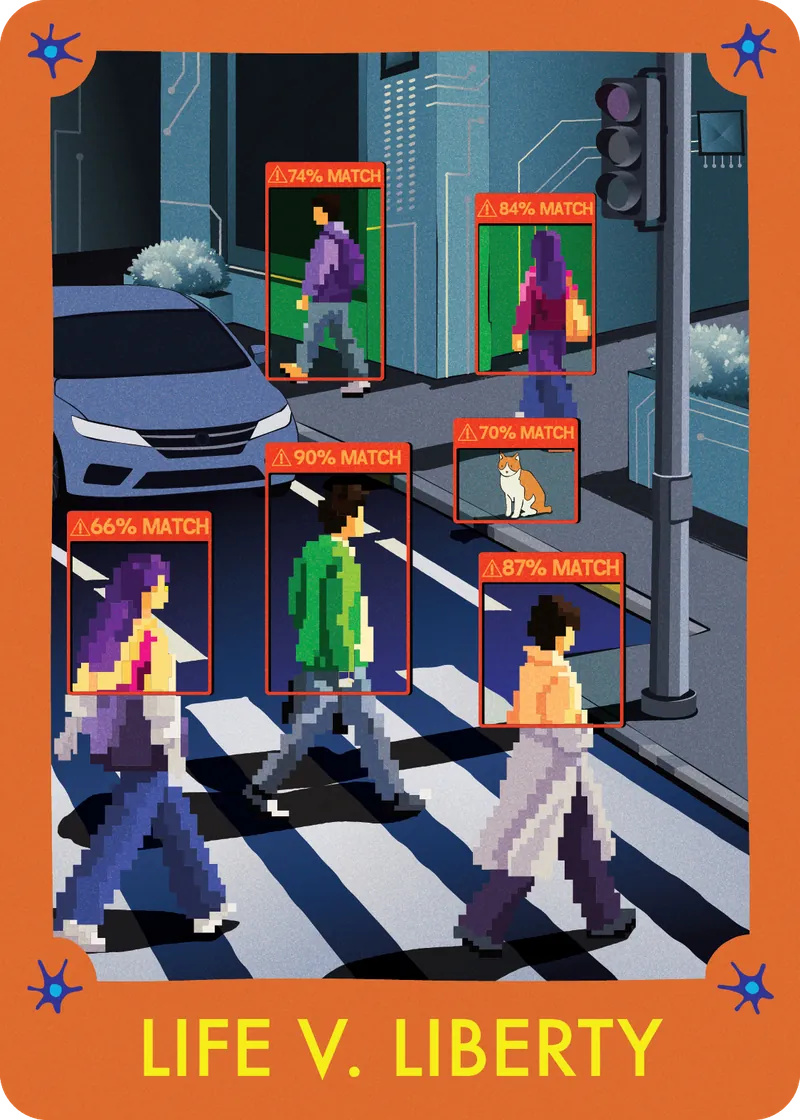
Life v. Liberty
Flip backa dilemma within preventive criminal law where public safety is weighed against the liberty of a few individuals.
Experts acknowledge a steep rise in the use of surveillance technology post the 26/11 Bombay attack. For a society which has internalised fear (See S; See F; See U;) the liberty of individuals who are watched, classified, and suspected is a fair cost to pay for public safety. The ‘high’ stakes of public life is often used as a shield for unregulated arbitrary deployment of mass surveillance. It exaggerates the distinction between the collective and the individual, undermining the widespread invasive impact of mass surveillance on the liberty of the public (See C).
See:Arun P, (2015) Power to Intercept, Monitor and Surveil: Cybersurveillance and Democracy in India.
 M
Memory of the Digital
Flip backthe enduring storage capacity of the digital record.
The digital record is presumed to be immune to pitfalls of human memory such as forgetting and subjective modifications. This faith in the capacity of the digital record transforms the perception of the people who are documented and remembered by criminal law registers. The capacity to record, store, retrieve and replay the captured communication, movement and behaviour reduces the burden on the system to debate the suspicion. The memory of the digital ensures that the suspicion shown on people is longer, stronger and totalising.
See:Merrill S, (2024), Remembering like a state: Surveillance databases, digital activist traces and the repressive potential of mediated prospective memory.
 N
Neutral
Flip backthe lack of capacity to develop prejudice.
Technology forces a massively complex society to be legible to the state by breaking down people’s identities, social life, actions and relationships into simplified isolated units. People are inputted as numbers, scans, DNAs and satellite traffic. In the context of mass surveillance, the dominant assumption is that this simplification enables technology to analyse crime, criminality, and violence neutrally (See B; See T). Yet the simplification requires de-realisation of individual lives. The production of such neutrality erases the nuances and interconnectedness of people’s personhood and social realities.
See:Arrigo B & Shaw O. P, (2023) The de-realization of Black bodies in an era of mass digital surveillance: A techno-criminological critique.
 O
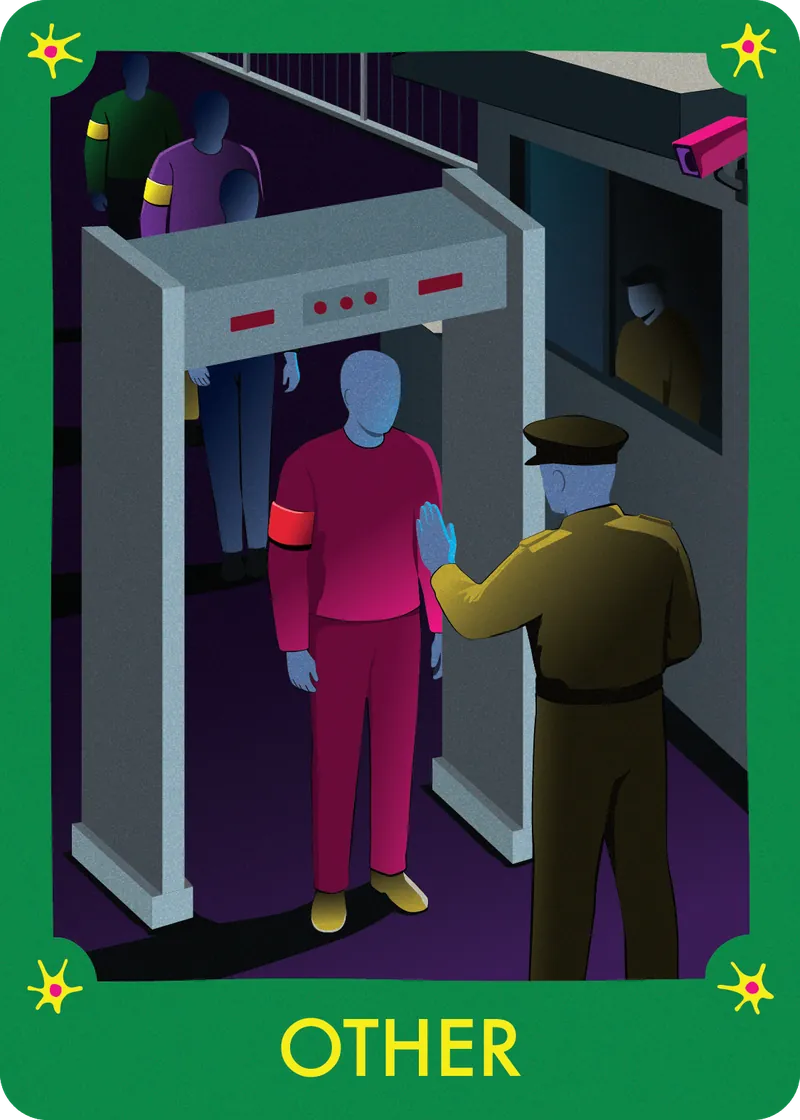
Other
Flip backthe sociological concept used for the socially and politically constructed outsider.
The garb of neutrality might make surveillance appear impartial. But people have unequal social and economic power to navigate the gaze and authority of surveillance and the policing which follows. Whether surveillance is working in service of us or against us depends on our intersecting social locations such as caste, class, ethnicity, religion, gender and sexuality. Hence, the ‘suspicious’ continues to be the socio-political ‘other.’ Through the legitimacy of neutrality (See N) and authority of scientific rigour (See H), mass surveillance marks the ‘otherness’ of certain communities in more permanent ways.
See:Lyon D, (2005) Surveillance as social sorting: Privacy, risk and automated discrimination.
 P
Punitive-welfare Nexus
Flip backthe overlaps between penal and welfare governance.
Use of mass surveillance for the purpose of policing is only one of the many ways in which the state uses technology to record and categorise people. In India, the expansion of biometric data collection is associated with AADHAR, originally developed to identify welfare beneficiaries. Mass surveillance infrastructure exists at the nexus between punitive and welfare functions of the state. The lack of regulation of surveilled data collected across state institutions, risks the reliance of coercive punitive governance on information not intended for executing such functions (See B).
See:Arun P, (2019) Penetrative or embracive? Exploring state, surveillance and democracy in India in Changing Contexts and Shifting Roles of the Indian State: New Perspectives on Development Dynamics.
 Q
Quagmire
Flip backa sinking depression in the ground getting increasingly steeper and dangerous to escape.
The landscape of mass surveillance is trapped in ambiguities and confusions regarding the legal framework (See P), targets of suspicion (See U; See G), grounds for invocation (See S) and principles guiding the interpretation of data (See K). The current use of surveillance is hence arbitrary and up to executive discretion. The development of mass surveillance infrastructure specifically for punitive purposes without clarity on the normative and legal framework governing it, makes surveillance an absurd and dangerous quagmire for society.
See:Aryan Babele, (2021) Intrusive tech-enabled surveillance and ‘National Security’ secrecy: mounting concerns of mass snooping amid informational asymmetry.
 R
Regime of Privacy
Flip backcentralising the violation of individual privacy as the major threat posed by mass surveillance.
The defence for individual privacy has been the strongest resistance against the unregulated use of mass surveillance. While the discourse validly critiques state invasion in the private sphere, it often ends up upholding an inaccurate distinction between surveillance of the public and the private (See: C; See D; See G). The considerations for privacy are diluted when suspicion is used to justify state intrusion (See O; See F) and innocence is proven through visibility (See V). Centralising the lens of privacy limits the critique of surveillance to be in service of only the ‘private.’ Additionally, it does not sufficiently engage with the punitive risks that emerge when surveillance and penal institutions interact.
See:Bennett C. J, (2011) In defense of privacy: The concept and the regime.
 S
Situation
Flip backa moment in the future that is yet to enter human experience.
Increasingly, governance is being oriented to manage an abstract future ‘situation.’ In the context of crime-management, this expands the state’s focus on crime-management (See H; See U; See F). Additionally, the capacity of the algorithm to comprehend future probabilities, motivates the deployment of mass surveillance in preventive policing. However, the ambiguity and abstractness of the situation also dilutes the threshold of what is considered a risk warranting surveillance. A fixation with the situation justifies invoking preventive policing and the desirability of mass surveillance. Simultaneously, the ambiguity of the situation dilutes the risk and reasonableness of preventive punitive intervention.
See:Arrigo B & Shaw O. P, (2023) The de-realization of Black bodies in an era of mass digital surveillance: A techno-criminological critique.
 T
Truth Machines
Flip backtechnologies of criminal investigations claiming the capacity to extract truth better and less violently than humans.
Much as other advanced technology, mass surveillance claims extra-human accuracy in its output. It also claims humaneness by reducing the witch-hunt of falsely accused individuals, or the necessity of using violence to extract truth. Technology claims that it reduces the violence of criminal justice institutions by providing a humane alternative to extraction of truth. However the mysticism of truth is broken by the subjectivity (See B) and prejudice (See O) of mass surveillance and how it generalises suspicion (See G; See S).
See:Jinee Lokaneeta, (2020) The Truth Machines: Policing, Violence, and Scientific Interrogations in India.
 U
Unknown
Flip backthat which can’t be known.
High modernist society aspires for predictability. The unknown becomes the site of anxiety. The ‘stranger’ (behaviour, person, lifestyle or thought) becomes threatening precisely because they cannot be easily placed within familiar categories. Mass surveillance responds to this social and political anxiety by, at least symbolically, assuring the capacity to identify, record, deconstruct, and reconstruct the potential stranger to make it familiar. This discomfort with the unknown (See F; See S) motivates the ways in which punitive institutions use mass surveillance.
See:Scott J.C, (1998) Seeing Like a State: How Certain Schemes to Improve the Human Condition Have Failed.
 V
Visible
Flip backthat which can be seen.
What is seen, can be known and what can be known can be managed (See H). People make themselves visible to the state by allowing the state to see, record and trace them through mass surveillance. Since the fear of the unknown creates anxiety in society (See U), making oneself visible is also a way to establish innocence. Resisting visibility makes one a suspect. Failing to produce markers of visibility invites doubt and possible penalisation.
See:Scott J.C, (1998) Seeing Like a State: How Certain Schemes to Improve the Human Condition Have Failed.
 W
Watching as a Way of Life
Flip backa cultural, historically pervasive social reality of ‘keeping a watch’ as part of everyday routine.
While mass surveillance involves the state and penal institutions in watching, it is also part of the ways in which individuals watch each other. This culture of watching is sustained by equating visibility with safety (See V). Yet the demand to watch and be watched may produce the opposite: a society organised around suspicion, insecurity, and paranoia. The more we seek to secure ourselves through surveillance, the more we see one another as threats requiring observation and regulation. Everyone is simultaneously suspect and spy but consequently both and neither.
See:Andrejevic M, (2004) The Work of Watching One Another: Lateral Surveillance, Risk, and Governance.
 X
X-ray
Flip backa dissected view revealing the unapparent.
A dissection of the quagmire of surveillance reveals a lack of intentional planning beneath the grandiosity of technological innovation. For instance, ABHIGYAAN app matches fingerprints against the National Fingerprint Identification System (NAFIS) and shows criminal cases registered against people in real time. However, an x-ray of the app reveals no clarity regarding: the grounds on which the police can demand fingerprint scans; the details of the prior registered cases and how they are connected with the particular preventive purpose and the consequence of a fingerprint match.
See:Anam J, (2026) Expanding biometric surveillance through mobile fingerprint identification.
 Y
‘You Are Under Surveillance’
Flip backa commonly used phrase that the law requires to be placed in public places under surveillance.
The widespread use of mass surveillance (See I), its vast capacity (See M; See G) and the punitive impact it can have on society (See C) portrays surveillance as an undefeatable force against people. However, the risks of surveillance should be comprehended alongside inadequacies of its current deployment (See Q; See X). An exaggerated understanding of surveillance as an all-consuming exceptional force risks reification of technology and hides the ways in which surveillance is embedded in pre-existing and more familiar cultures of discipline (See D), watching (See W; See O; See U) and contemporary systems of governance (See S; See V).
See:Van der Ploeg I, (2003), Biometrics and Privacy A note on the politics of theorizing technology.
 Z
Zapped
Flip backto have attention be saturated by frequent change in stimuli leaving little possibility to analyse them.
There is an increasing frequency with which mass surveillance projects are operationalised in India. Multiple surveillance programmes are rolled out as a symbolic message regarding the high-modernist constitution of the state. This proliferation of digital jargon, new methods of documenting, new tasks for the algorithm leave little to no room to critically examine the ambiguity and the punitive risks beneath these programmes.
See:Mulligan D. K & Bamberger K. A, (2018). Saving governance-by-design.
Acknowledgements
Read the full acknowledgements (PDF)(opens in a new tab)Credits
- Project Lead and Author
- Saniya Rizwan
- Illustration
- Knowell Advertising
- Design Ideation
- Vanshika Kabra & Knowell Advertising
- Design Coordination
- Vanshika Kabra and Fizza
- Licence
- CC BY-NC-SA 4.0, October 2026
Bibliography
- Verhelst HM, Stannat AW and Mecacci G, (2020) Machine Learning Against Terrorism: How Big Data Collection and Analysis Influences the Privacy-Security Dilemma. (A)
- S Narayan, (2023) Predictive Policing and the Construction of the ‘Criminal’: An Ethnographic Study of Delhi Police. (B, K)
- Murray D, Fussey P, Hove K, Wakabi W, Kimumwe P, Saki O and Stevens A, (2024) The Chilling Effects of Surveillance and Human Rights: Insights from Qualitative Research in Uganda and Zimbabwe. (C)
- Foucault M, (1975) Discipline and Punish: The Birth of the Prison. (D)
- Hayward K, (2026) Criminology and the smart city paradigm: ‘Preventative technical imaginary’ or ‘Techlash’ vector? (E)
- Neocleous M & Rigakos G. S, (2011) Anti-security. (F)
- Brayne S, (2017) Big data surveillance: The case of policing. (G)
- Scott J.C, (1998) Seeing Like a State: How Certain Schemes to Improve the Human Condition Have Failed. (H, U, V)
- Agarwal B, & Saxena S, (2026) Digital Panopticons on Wheels: A Comparative Legal Analysis of Police Vehicle Tracking and Surveillance in India, West, and South Asia in The Intersection of Technology and Criminal Justice. (I)
- Arun P, (2019) Penetrative or embracive? Exploring state, surveillance and democracy in India in Changing Contexts and Shifting Roles of the Indian State: New Perspectives on Development Dynamics. (J, P)
- Arun P, (2015) Power to Intercept, Monitor and Surveil: Cybersurveillance and Democracy in India. (L)
- Merrill S, (2024), Remembering like a state: Surveillance databases, digital activist traces and the repressive potential of mediated prospective memory. (M)
- Arrigo B & Shaw O. P, (2023) The de-realization of Black bodies in an era of mass digital surveillance: A techno-criminological critique. (N, S)
- Lyon D, (2005) Surveillance as social sorting: Privacy, risk and automated discrimination. (O)
- Aryan Babele, (2021) Intrusive tech-enabled surveillance and ‘National Security’ secrecy: mounting concerns of mass snooping amid informational asymmetry. (Q)
- Bennett C. J, (2011) In defense of privacy: The concept and the regime. (R)
- Jinee Lokaneeta, (2020) The Truth Machines: Policing, Violence, and Scientific Interrogations in India. (T)
- Andrejevic M, (2004) The Work of Watching One Another: Lateral Surveillance, Risk, and Governance. (W)
- Anam J, (2026) Expanding biometric surveillance through mobile fingerprint identification. (X)
- Van der Ploeg I, (2003), Biometrics and Privacy A note on the politics of theorizing technology. (Y)
- Mulligan D. K & Bamberger K. A, (2018). Saving governance-by-design. (Z)